Discovery of novel Four-toed Salamander (Hemidactylium scutatum) occurrences in New Brunswick, Canada
DOI :
https://doi.org/10.22621/cfn.v139i1.3403Mots-clés :
Atlantic Canada, amphibian, geographic distribution, Hemidactylium scutatum, Plethodontidae, the MaritimesRésumé
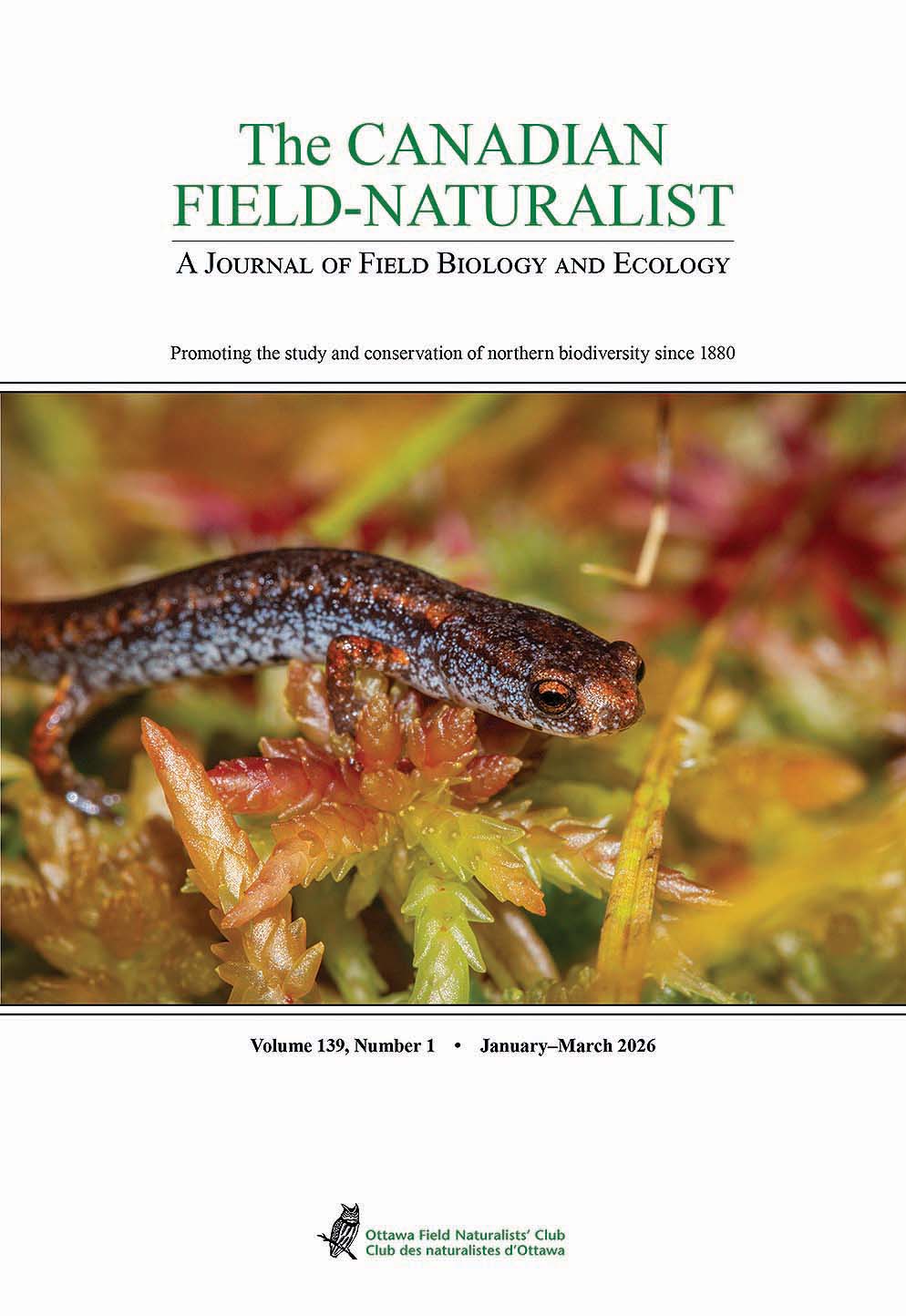
Four-toed Salamander (Hemidactylium scutatum) has the broadest geographic distribution of any North American plethodontid. However, in New Brunswick, Canada, its known distribution has previously been limited to a single site in Fundy National Park, where the species was first confirmed in 1983, its presence verified until at least 2012, and where it is still presumed to occur. Recently, during a series of general amphibian surveys and opportunistic observations, novel occurrences of this species were discovered. Specifically, we observed eight individuals at two sites in the town of Riverview, 59 km northeast of the Fundy National Park site. Our discovery expands knowledge of the species in New Brunswick and the northern limit of its distribution. The Riverview sites are relatively disturbed (e.g., high human foot traffic, all-terrain vehicle use, some incidental tree harvest, invasive plant species, infrastructure development, and litter). The Riverview High School forest site is isolated from other forested areas by paved roads. There are major differences between these sites and where the species has previously been observed in New Brunswick: the Fundy National Park site is relatively undisturbed and surrounded by extensive forest. This suggests that populations of this species in New Brunswick can persist in marginal, patchy, anthropogenically-disturbed habitat, which has implications for conservation and management.
Téléchargements
Publié-e
Numéro
Rubrique
Licence
Copyright for Canadian Field-Naturalist content is held by the Ottawa Field-Naturalists' Club, except for content published by employees of federal government departments, in which case the copyright is held by the Crown. In-copyright content available at the Biodiversity Heritage Library is available for re-use under a Creative Commons Attribution-NonCommercial-ShareAlike 4.0 (CC BY-NC-SA 4.0) licence. For usage of content at the BHL for purposes other than those allowed under this licence, contact us.
To request use of copyright material, please contact our editor, Dr. Dwayne Lepitzki: editor -at- canadianfieldnaturalist -dot- ca