A field survey of anuran species in two boreal lakes at the Experimental Lakes Area, Ontario, Canada
DOI:
https://doi.org/10.22621/cfn.v139i2.3541Keywords:
field survey, frog, Ontario, toad, Freshwater lakes, boreal, amphibian communityAbstract
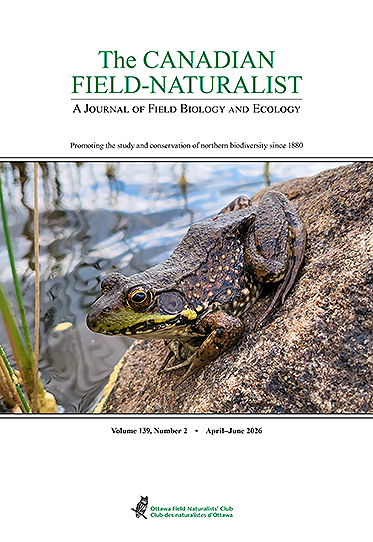
With over 60% of Canada’s amphibian species at-risk, field surveys and studies can contribute important knowledge to better inform assessments and conservation efforts. The diversity of amphibians inhabiting lakes, specifically semi-remote boreal lakes, has been relatively understudied compared to wetlands and temporary waterbodies. The goal of our study was to survey the anuran species associated with freshwater boreal lakes in a historically undocumented area in northwestern Ontario, Canada. In May–August 2022, we conducted egg surveys, larval surveys, and automated call recording surveys at two boreal lakes at the International Institute of Sustainable Development-Experimental Lakes Area. We detected seven anurans: American Toad (Anaxyrus americanus), Gray Treefrog (Hyla versicolor), Green Frog (Lithobates clamitans), Mink Frog (Lithobates septentrionalis), Northern Leopard Frog (Lithobates pipiens), Spring Peeper (Pseudacris crucifer), and Wood Frog (Lithobates sylvaticus). We also incidentally detected adult Central Newt (Notophthalmus viridescens louisianensis). American Toad was the most extensively detected species among our survey methods, with all life stages detected. In contrast, Northern Leopard Frog was infrequently detected in calling surveys at one lake. Although anuran populations can vary annually and within relatively small spatial scales, our results suggest that freshwater boreal lakes harbour a diversity of anurans and should not be overlooked as valuable amphibian habitat. As anthropogenic impacts continue to threaten boreal ecosystems, our surveys provide baseline knowledge of anurans in these semi-remote boreal lakes of Canada, critical for further studies and amphibian conservation efforts.
Downloads
Published
Issue
Section
License
Copyright for Canadian Field-Naturalist content is held by the Ottawa Field-Naturalists' Club, except for content published by employees of federal government departments, in which case the copyright is held by the Crown. In-copyright content available at the Biodiversity Heritage Library is available for re-use under a Creative Commons Attribution-NonCommercial-ShareAlike 4.0 (CC BY-NC-SA 4.0) licence. For usage of content at the BHL for purposes other than those allowed under this licence, contact us.
To request use of copyright material, please contact our editor, Dr. Dwayne Lepitzki: editor -at- canadianfieldnaturalist -dot- ca