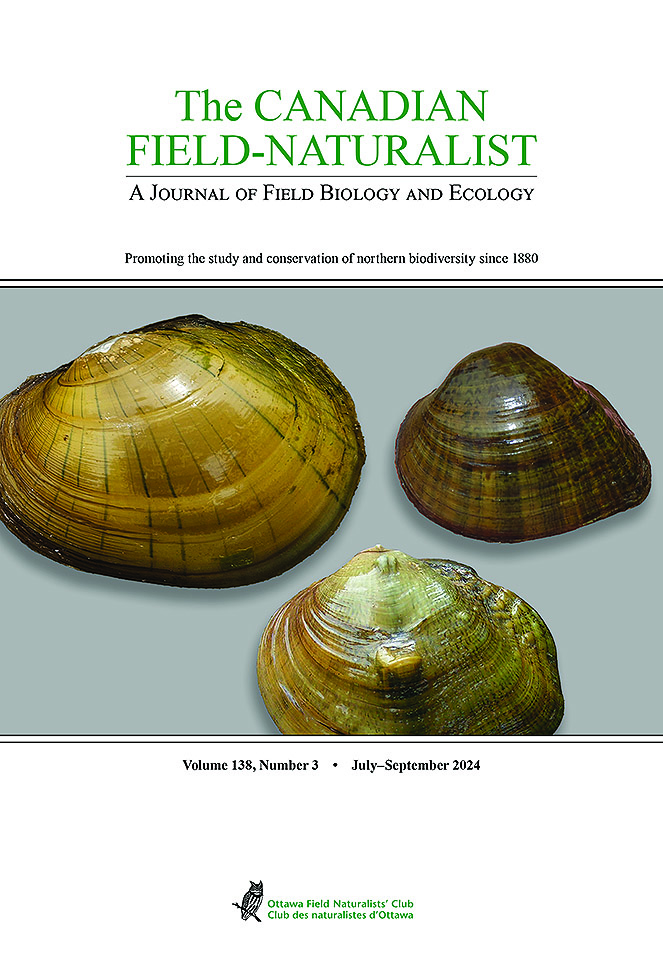
A The history of commercial freshwater mussel harvest in southern Ontario: a short-lived fishery with long-lasting consequences
DOI:
https://doi.org/10.22621/cfn.v138i3.3391Keywords:
Bivalvia, Unionidae, history, button industry, Grand River, Thames RiverAbstract
Freshwater mussels (Bivalvia: Unionidae) have long been an important aquatic resource for humans, and North America’s
Indigenous nations have harvested them for over 10 000 years. European exploitation began in the latter half of the 19th century, initially focussing on the collection of pearls and later shifting to the manufacture of buttons at the onset of the 20th century. By 1911, Canadian pearl button factories operated in Windsor, Berlin (now Kitchener), and Trenton, Ontario, and, by 1921, Ontario shell was being exported to factories in the United States. The Canadian harvest did not last long and ended by the mid-1940s as resources dwindled because of overexploitation, pollution, and industrial shifts to other raw materials for buttons (e.g., plastics). Annual river-specific harvest ranged from ~ 66 to 110 tonnes with a maximum of 291 tonnes (~1.1–4.4 million animals) collected at Dunnville on the lower Grand River in 1915. Although detailed collection information is lacking, species such as Mucket (Actinonaias ligamentina), Threeridge (Amblema plicata), and Round Pigtoe (Pleurobema sintoxia, now listed federally as Endangered) were targetted, while Purple Wartyback (Cyclonaias tuberculata, also now Endangered) was discarded (i.e., killed). Commercial harvests typically targetted adults, because they provided the desired quantity and type of material, resulting in death. Recent studies have shown that this type of directed mortality can have the greatest impact on the long-term persistence of these populations and, although the specific impacts of the historical harvest cannot be determined, it is likely that these harvests contributed to the current state of imperilment of this fauna.
Downloads
Published
Issue
Section
License
Copyright for Canadian Field-Naturalist content is held by the Ottawa Field-Naturalists' Club, except for content published by employees of federal government departments, in which case the copyright is held by the Crown. In-copyright content available at the Biodiversity Heritage Library is available for re-use under a Creative Commons Attribution-NonCommercial-ShareAlike 4.0 (CC BY-NC-SA 4.0) licence. For usage of content at the BHL for purposes other than those allowed under this licence, contact us.
To request use of copyright material, please contact our editor, Dr. Dwayne Lepitzki: editor -at- canadianfieldnaturalist -dot- ca